
Almanac
Clearer thinking, one model a day
£23.99

Almanac
365 mental models for clearer thinking
Stories · Drawings · A year of reading
£23.99
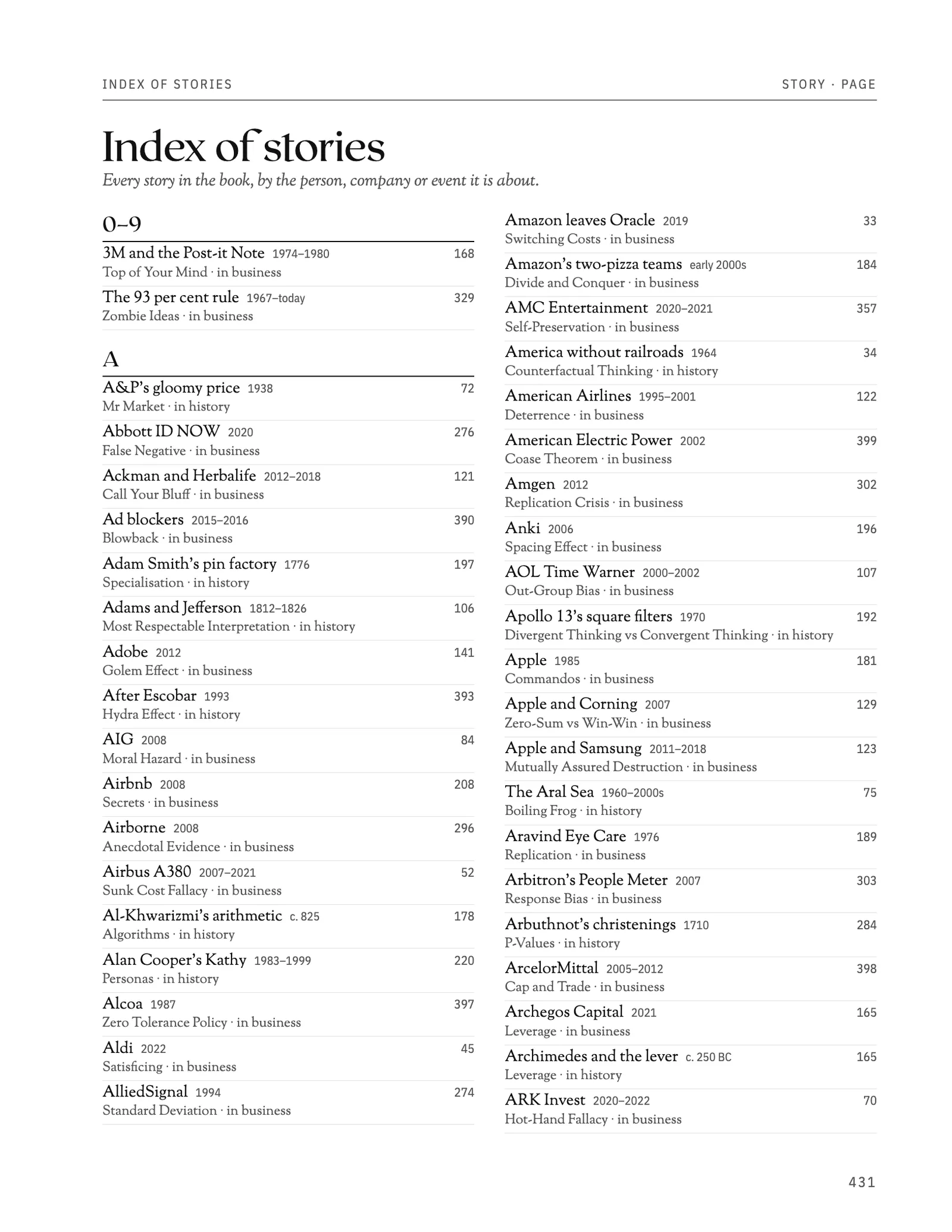
365 mental models for clearer thinking, with 730 stories: one model for every day of the year.
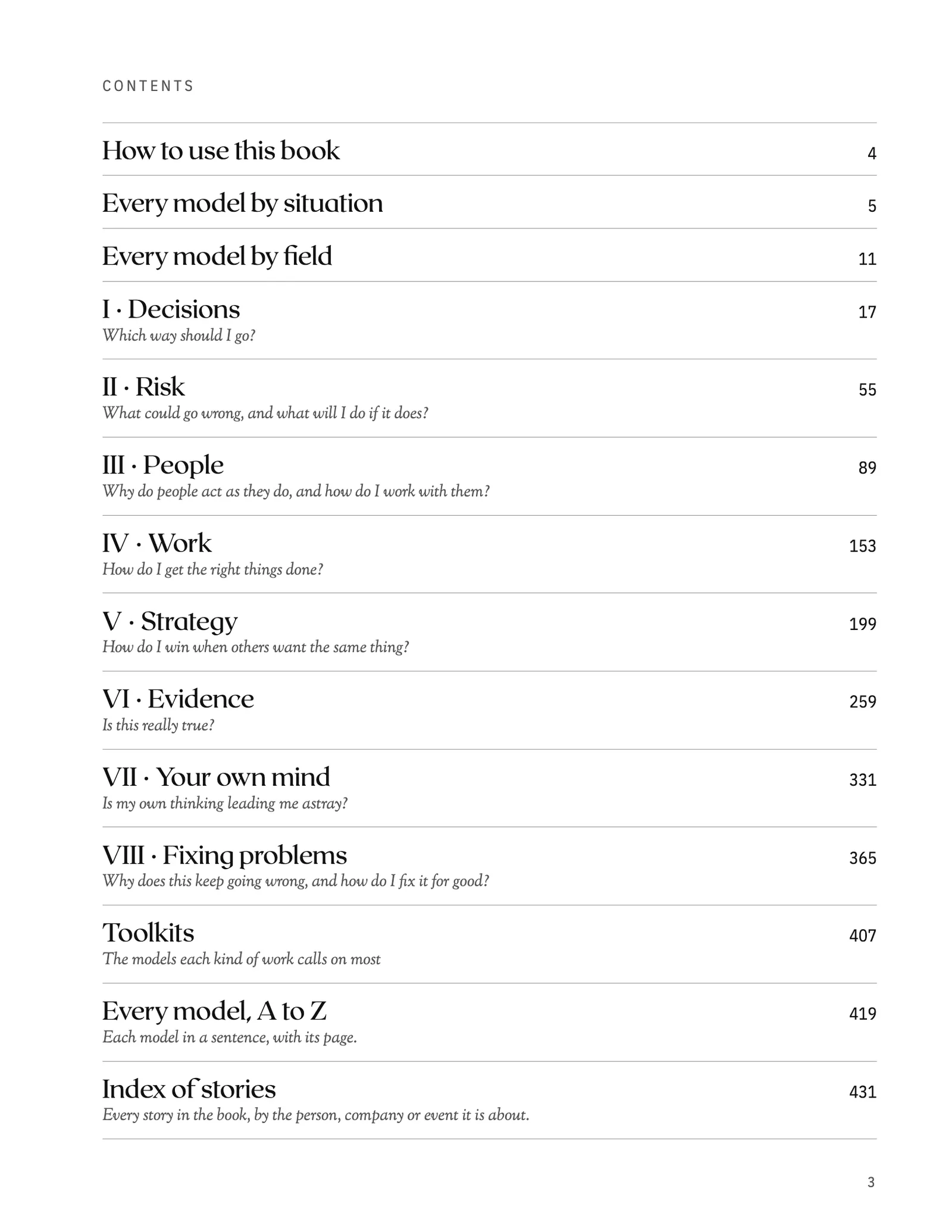
Mental models are the shortcuts clear thinkers use to cut through noise and decide well. This almanac gathers 365 of them, one for every day of the year, from Inversion and Second-Order Thinking to Hanlon’s Razor, Bayes’ Theorem and the Lindy Effect, and gives each one a single, illustrated page in a large, easy-to-read format.
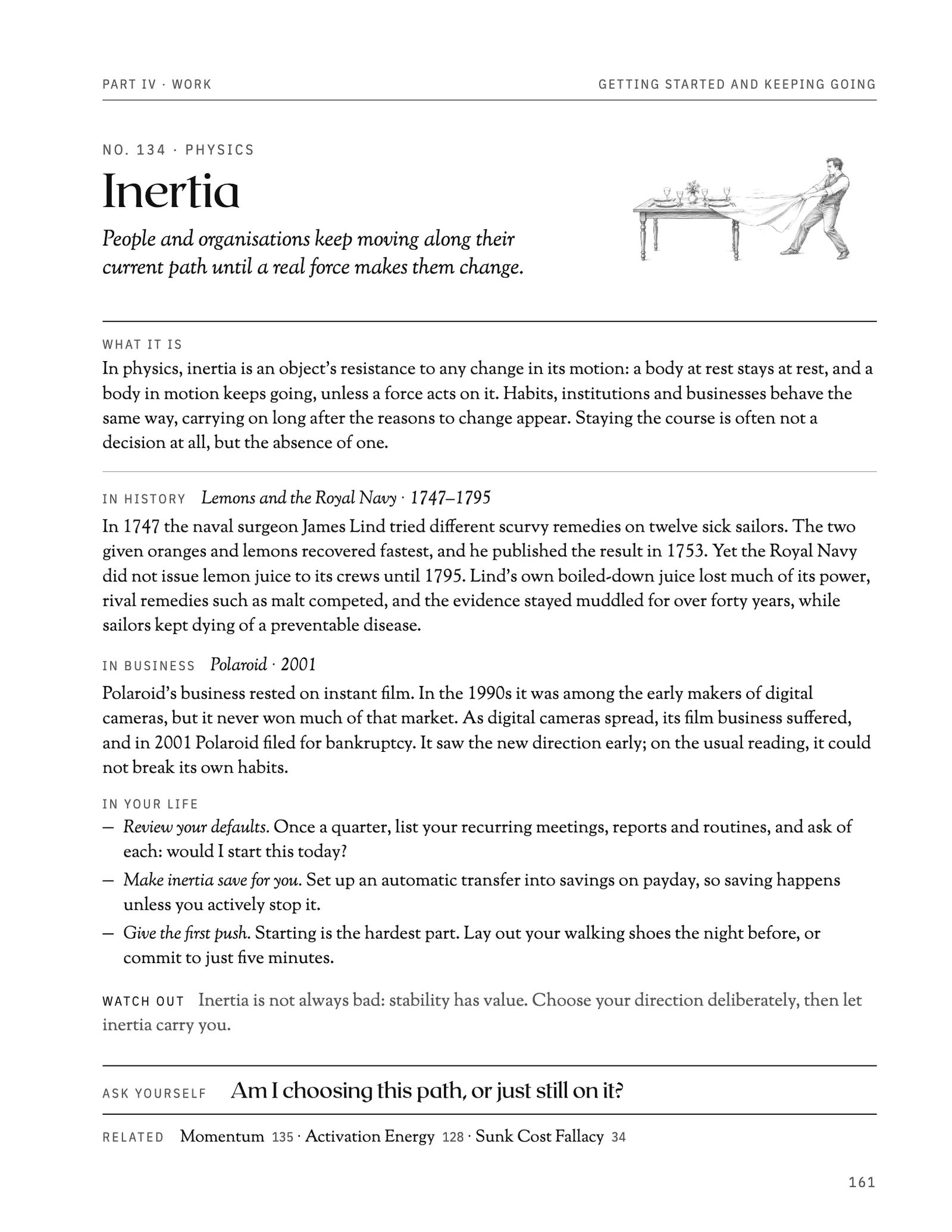
Each page explains the idea in plain words, tells a story from history and one from business, offers three small ways to use it this week, warns where it misleads, and ends with a question to carry with you.
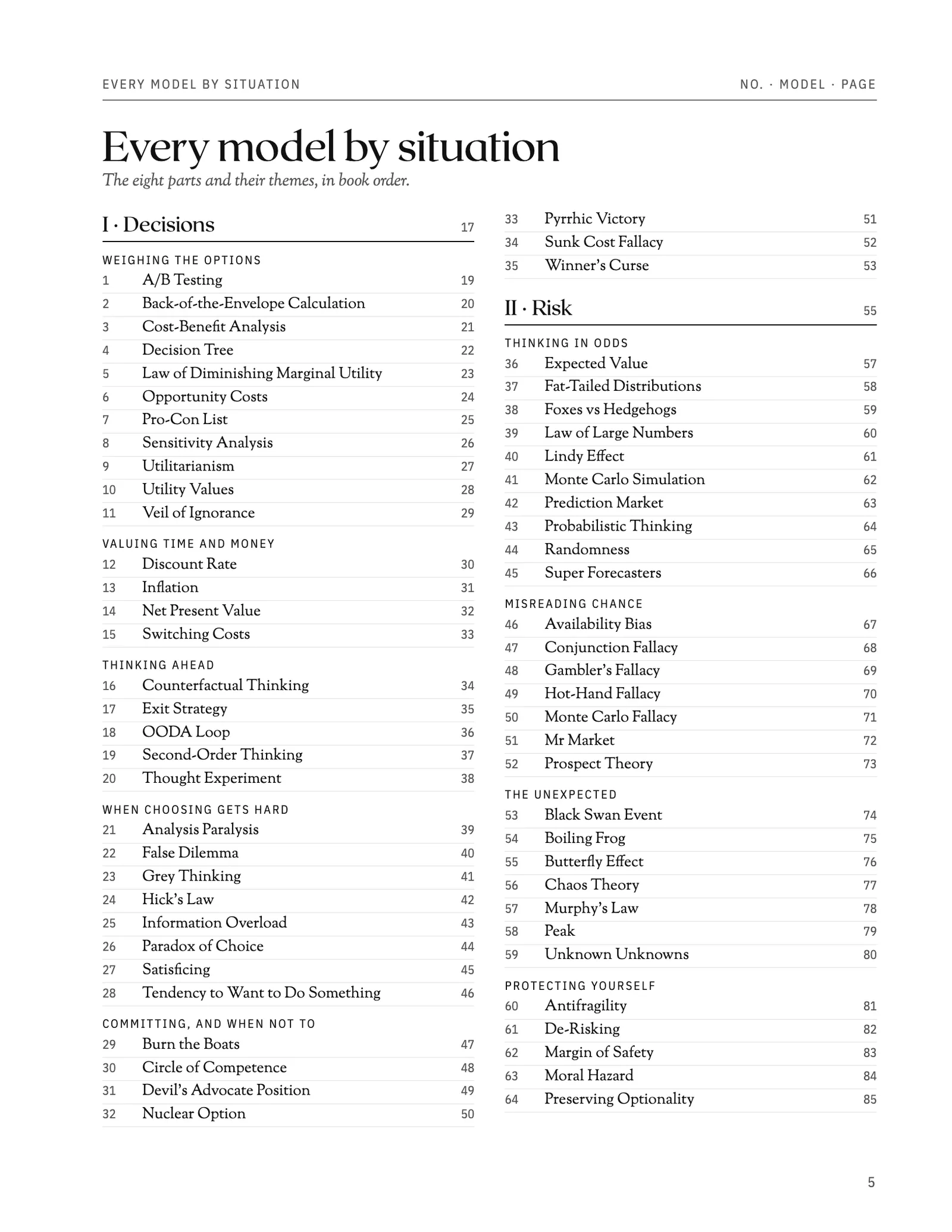
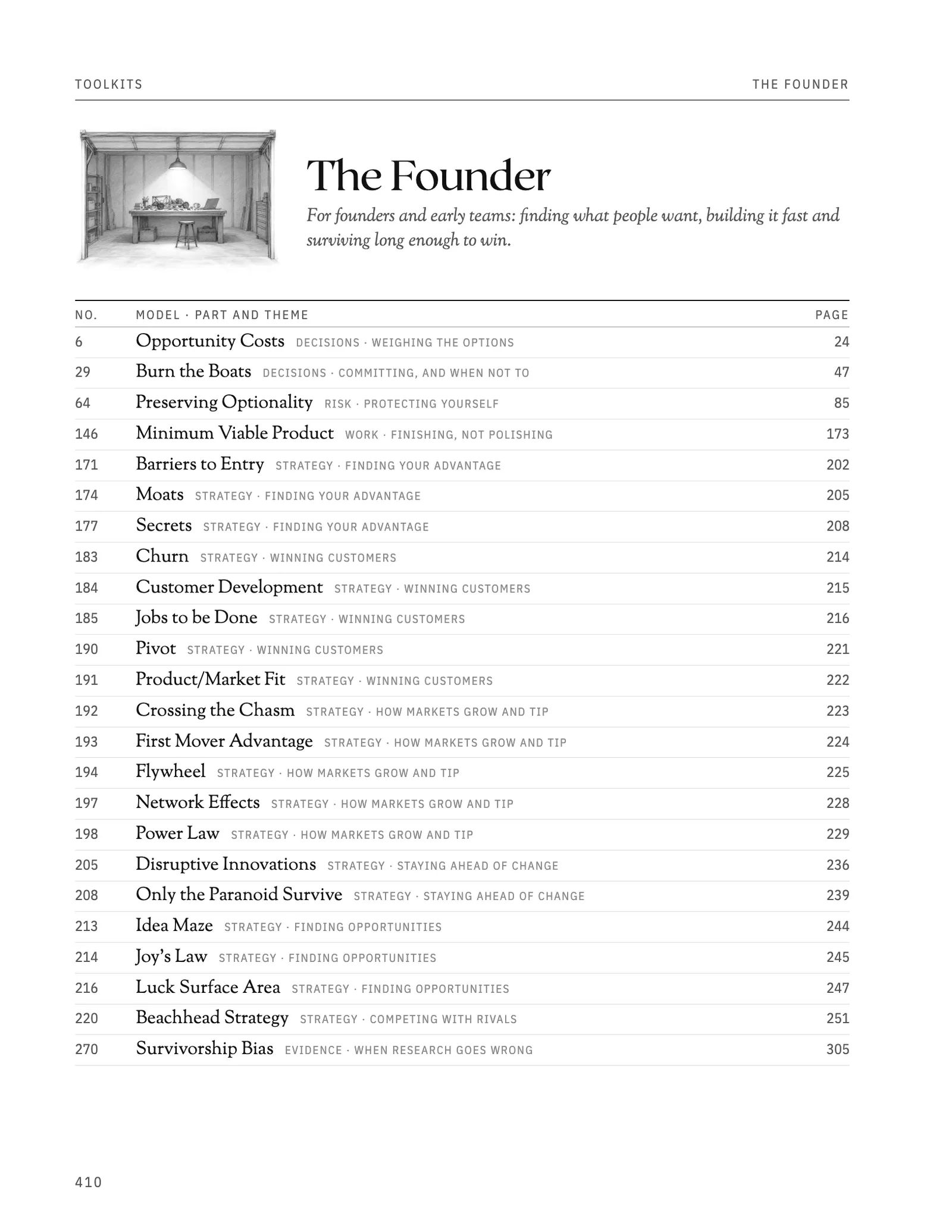
A/B Testing Back-of-the-Envelope Calculation Cost-Benefit Analysis Decision Tree Law of Diminishing Marginal Utility Opportunity Costs Pro-Con List Sensitivity Analysis Utilitarianism Utility Values Veil of Ignorance Discount Rate Inflation Net Present Value Switching Costs Counterfactual Thinking Exit Strategy OODA Loop Second-Order Thinking Thought Experiment Analysis Paralysis False Dilemma Grey Thinking Hick’s Law Information Overload Paradox of Choice Satisficing Tendency to Want to Do Something Burn the Boats Circle of Competence Devil’s Advocate Position Nuclear Option Pyrrhic Victory Sunk Cost Fallacy Winner’s Curse Expected Value Fat-Tailed Distributions Foxes vs Hedgehogs Law of Large Numbers Lindy Effect Monte Carlo Simulation Prediction Market Probabilistic Thinking Randomness Super Forecasters Availability Bias Conjunction Fallacy Gambler’s Fallacy Hot-Hand Fallacy Monte Carlo Fallacy Mr Market Prospect Theory Black Swan Event Boiling Frog Butterfly Effect Chaos Theory Murphy’s Law Peak Unknown Unknowns Antifragility De-Risking Margin of Safety Moral Hazard Preserving Optionality Resilience Scenario Analysis Stop the Bleeding Frame of Reference High Context vs Low Context Introverts vs Extroverts IQ vs EQ Language Instinct Maslow’s Hierarchy of Needs Peak-end Rule Theory of Mind False Consensus Effect Fundamental Attribution Error Halo Effect Hanlon’s Razor Horn Effect In-Group Favouritism Most Respectable Interpretation Out-Group Bias Liking and Loving Tendency Anchoring Backfire Effect Bait and Switch Dark Patterns Framing Nudging Reciprocity Social Proof Streisand Effect Winning Hearts and Minds Appeasement Best Alternative to a Negotiated Agreement Call Your Bluff Deterrence Mutually Assured Destruction Polarity Redline Sayre’s Law Strawman Fallacy Trojan Horse Zero-Sum vs Win-Win Cooperation Free Rider Problem Game Theory Pirate Code Prisoner’s Dilemma Social Norms vs Market Norms Tit for Tat Tragedy of the Commons Trust Carrot and Stick Distributive Justice vs Procedural Justice Golem Effect Managing to the Person Peter Principle Principal-Agent Problem Pygmalion Effect Bystander Effect Chilling Effect Dunbar’s Number Groupthink Hierarchical Organisation Power Vacuum Activation Energy Catalysts Compounding Effect Conditioning Dopamine Loop Forcing Function Inertia Momentum Bikeshedding Law of Diminishing Returns Leverage Manager’s Schedule vs Maker’s Schedule Pareto Principle Top of Your Mind Two-Front War Tyranny of Small Decisions Velocity Hofstadter’s Law Minimum Viable Product Mythical Man-Month Perfect is the Enemy of Good Premature Optimisation Unforced Error Algorithms Boots on the Ground Cargo Cult Commandos Crowdsourcing Directly Responsible Individuals Divide and Conquer Double-Entry Bookkeeping Entropy Institutional Knowledge Parallel Processing Replication Comparative Advantage Deliberate Practice Divergent Thinking vs Convergent Thinking Generalist vs Specialists Potential Energy Resonant Frequency Spacing Effect Specialisation Barriers to Entry Center of Gravity Economies of Scale Moats Niches Punching Above Your Weight Secrets Seizing the Middle Sustainable Competitive Advantage Trademarks Adverse Selection Apostle Model Churn Customer Development Jobs to be Done Lock-in Loss Leader Strategy Loyalists vs Mercenaries Personas Pivot Product/Market Fit Crossing the Chasm First Mover Advantage Flywheel Long Tail Metcalfe’s Law Network Effects Power Law S-Curves Supply and Demand Technology Adoption Lifecycle Winner Takes Most Markets Creative Destruction Cultural Evolution Disruptive Innovations Generals Fighting the Last War Natural Selection Only the Paranoid Survive Paradigm Shift Red Queen Effect Survival of the Fittest Arbitrage Idea Maze Joy’s Law Local Optimum vs Global Optimum Luck Surface Area Simultaneous Invention Arms Race Asymmetric Warfare Beachhead Strategy Counter-Insurgency Flypaper Theory Guerrilla Warfare Nash Equilibrium Strategy vs Tactics War of Attrition Base Rate Fallacy Bayes’ Theorem Central Limit Theorem Conditional Probability Confidence Interval Distributions Error Bars Frequentists vs Bayesians Mean, Median and Mode Normal Distribution Probability Distribution Regression to the Mean Standard Deviation Variance False Negative False Positive Falsification Hypothesis Inductive Reasoning Meta-Analysis Null Hypothesis Occam’s Razor P-Values Placebo Effect Randomised Controlled Experiments Scientific Method Statistical Significance Systematic Review Causal Fallacy Clustering Illusion Confounding Factor Correlation and Causation Regression Fallacy Texas Sharpshooter Fallacy Anecdotal Evidence Data Dredging Hasty Generalisation Non-Response Bias Overgeneralising from Small Samples Publication Bias Replication Crisis Response Bias Selection Bias Survivorship Bias Ad Hominem Appeal to Authority Appeal to Emotion Appeal to Ignorance Appeal to Pity Bandwagon Fallacy Black and White Fallacy Circular Argument Equivocation Non Sequitur Red Herring Fallacy Slippery Slope Tu Quoque Bias from Incentives Echo Chambers Filter Bubble Garbage In Garbage Out Heisenberg Uncertainty Principle Narrative Instinct Observer Effect Potemkin Village Proxy The Map is not the Territory Zombie Ideas Blind Spot Bias Cognitive Dissonance Commitment and Consistency Bias Confirmation Bias Denial First-Conclusion Bias Hindsight Bias Observer-Expectancy Bias Semmelweis Reflex Tendency to Stereotype Birth Lottery Dunning-Kruger Effect Fixed Mindset vs Growth Mindset Imposter Syndrome Just World Hypothesis Optimism Bias Self-Serving Bias Victim Blame Deprival-Superreaction Tendency Fear Freudian Slip Influence of Stress Loss Aversion Scarcity Self-Preservation Disliking and Hating Tendency Envy and Jealousy Tendency Bandwagon Effect Gateway Drug Theory Grass is Greener Mentality Relativity Black Box First Principles Thinking Inversion Lateral Thinking Maslow’s Hammer Post Mortem Proximate vs Root Cause Reframe the Problem The 5 Whys Bottlenecks Ecosystems Feedback Loops Homeostasis Hysteresis Le Chatelier’s Principle Broken Windows Theory Chain Reaction Containment Critical Mass Domino Effect Herd Immunity Quarantine Tipping Point Blowback Cobra Effect Collateral Damage Hydra Effect Jevons Paradox Law of Unintended Consequences Spillover Effects Zero Tolerance Policy Cap and Trade Coase Theorem Goodhart’s Law Government Failure Incentives Market Failure Perverse Incentives Regulatory Capture Shirky Principle